

Tom Wickenden
6 minutes reading time
- Global shares


After several years of strong performance, global defence stocks have recently stalled, with returns flattening over the past six months[i]. The slowdown comes at a counterintuitive time, as the US’s war in Iran is depleting American stockpiles and reinforcing Europe’s need to strengthen its own defence capabilities.
The first 12 days of the Iran conflict alone are estimated to have cost the US around US$16.5 billion[ii], a reminder of how quickly modern warfare depletes equipment. In response, the US is planning a sharp increase in defence spending, with a proposed budget of around US$1.5 trillion. If approved, it would represent the most significant year-on-year defence budget growth in history[iii].
Importantly, that spending is expected to flow not only to traditional defence contractors, but also to newer players focused on areas like AI, cyber security and autonomous systems, areas that are becoming central to how wars are fought.
For investors, this matters because defence companies don’t just benefit from current conflicts, they benefit from the years of rebuilding, re-arming and technological upgrade cycles that follow.
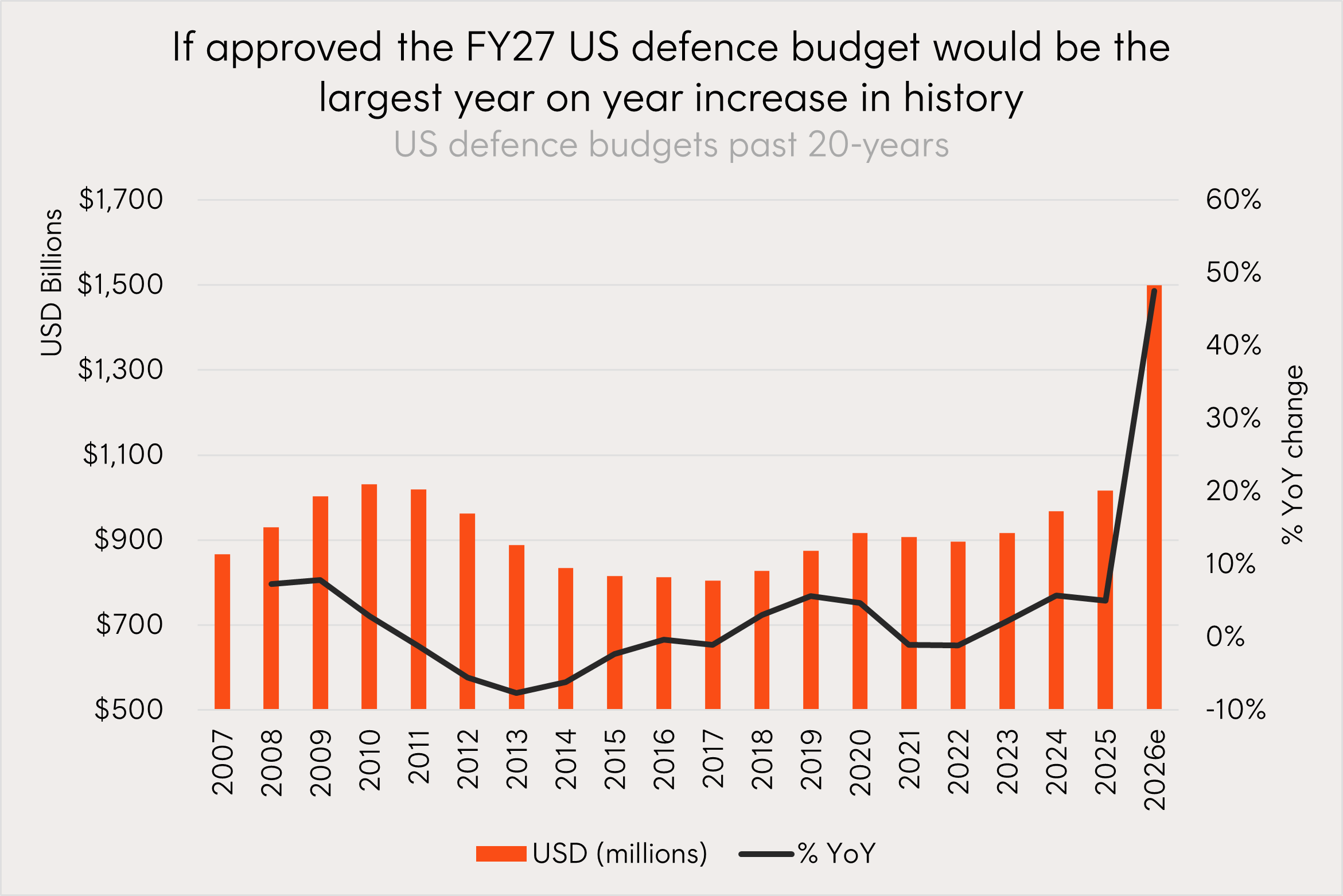
Source: SIPRI Military Expenditure Database, Betashares. 2007 to 2025. 2026e reflects proposed budget. Actual results may differ materially from forecasts.
So why are defence stocks down?
European defence companies have been the main reason the global defence sector’s performance has recently slowed.
Following significant gains last year on increased spending plans, including NATO’s 5% of GDP target and Germany’s historic debt reform, investors have taken a pause. Partly, this reflects high valuations but also the reality that it takes time for government spending to flow through to company profits.
At the same time, the long-term outlook for European defence spending continues to strengthen. Europe has historically relied on the US for its security, but growing uncertainty around how much support the US will provide, particularly during periods of global conflict, is pushing European governments to increase defence spending targets so they can protect themselves independently. Despite this, European defence company share prices have fallen significantly in recent months, resetting to levels seen roughly a year ago[iv].
The current pullback may offer long-term investors a more attractive entry point into a sector with long-lasting growth drivers and which is also being used by some investors as a ‘geopolitical hedge’ amid ongoing global uncertainty.
While valuations do remain elevated, these higher valuations increasingly reflect expectations of sustained profit growth rather than hype.
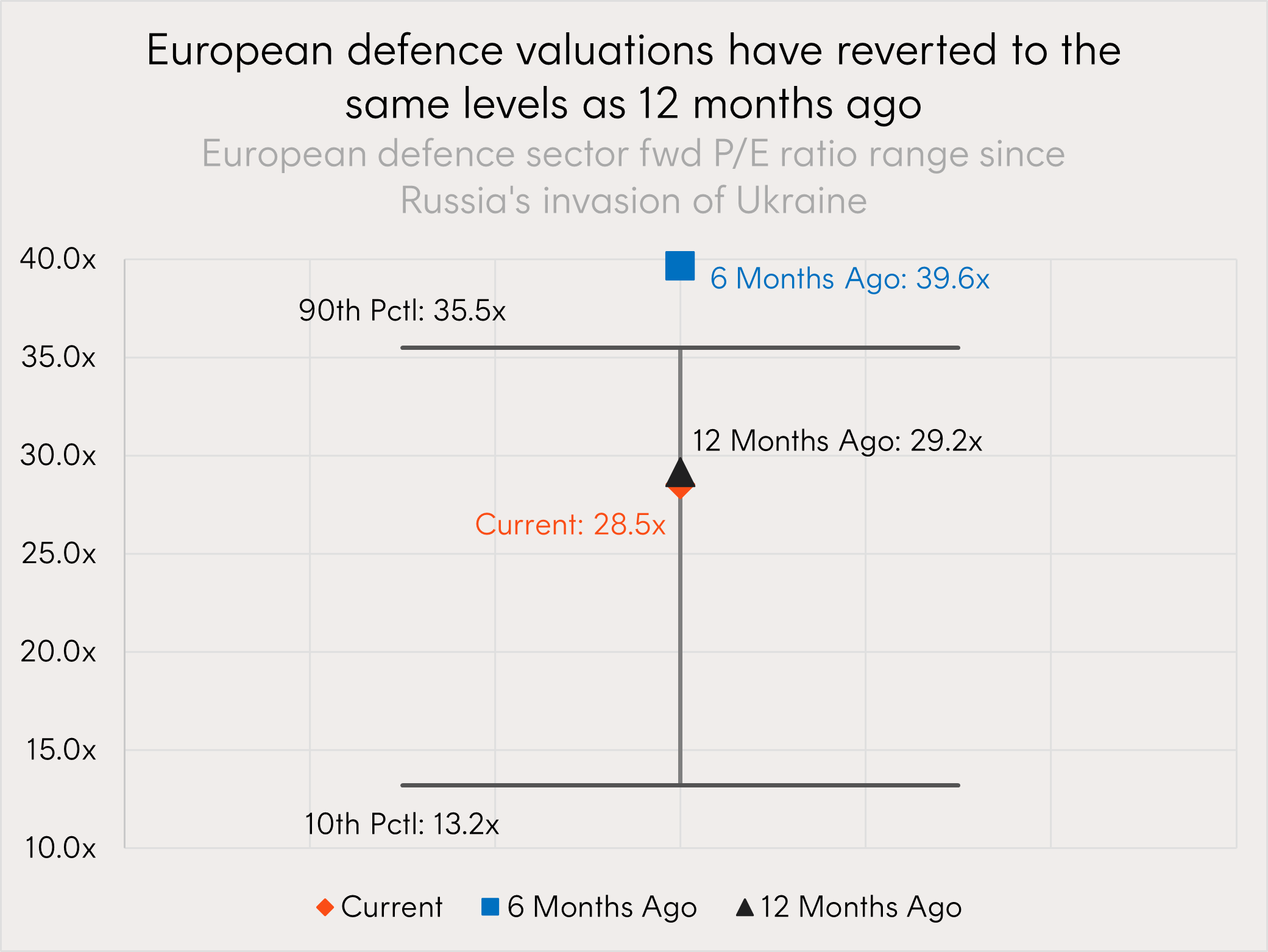
Source: Bloomberg, Betashares. 24 February 2022 to 31 March 2026. 10th and 90th percentile range. Past performance is not an indicator of future performance.
As a result of global spending developments, for the second year in a row major defence contractors saw their order books grow by over US$100bn[v]. The defence contractor order books we track now collectively exceeded US$1 trillion for the first time in history [vi]. Record levels of contracted future orders are a positive sign for future profit growth and may support a sustained longer-term rise in defence company share prices.
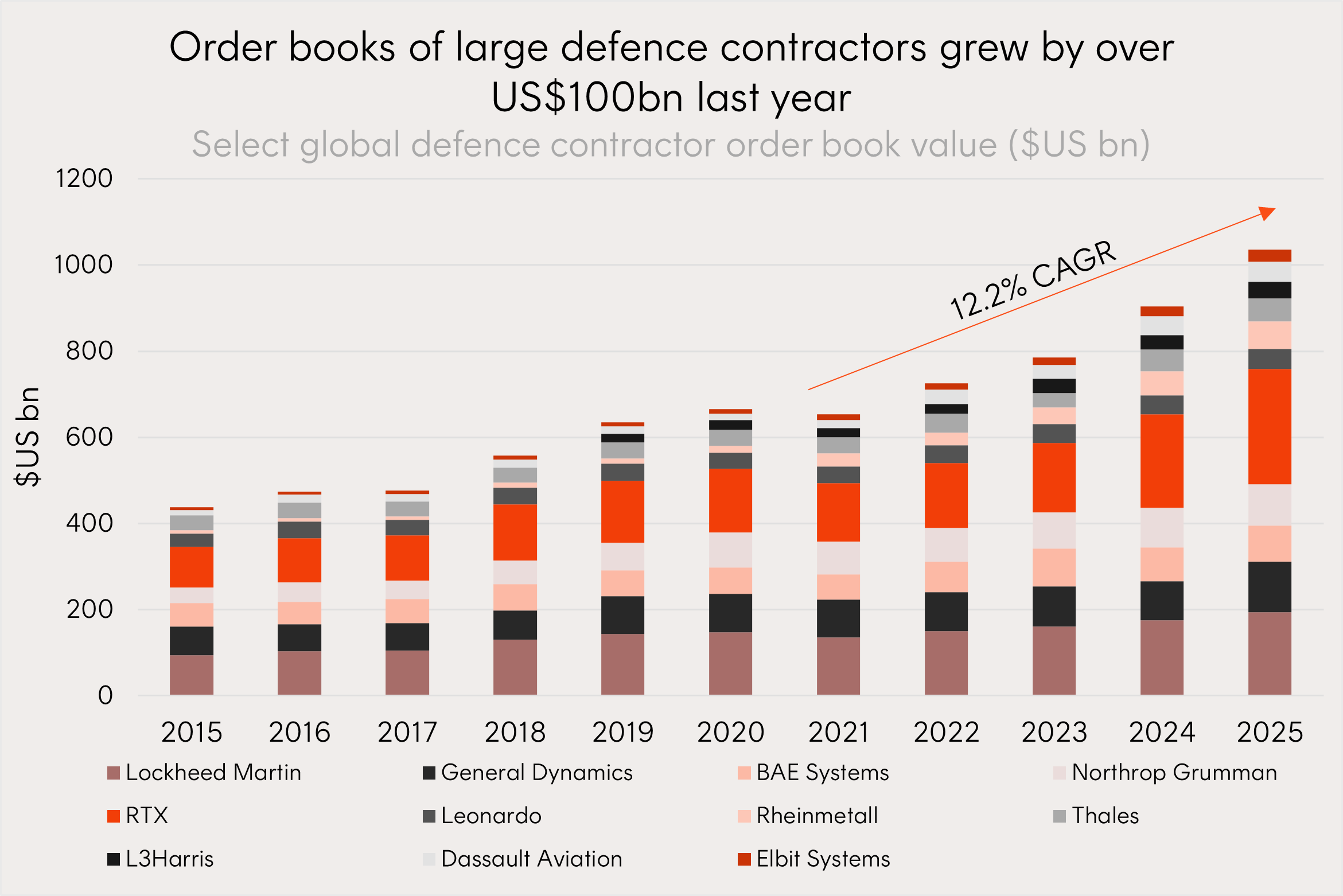
Source: Bloomberg, Betashares. Backlog order book value of select global defence contractors 2015 to 2025.
Investment implications
While the Iran war is likely to lead to increased spending to restock US inventories and reinforces the need for Europe to boost its defence capabilities, it may be the longer-term implications that matter most for investors, long after any resolution in Iran.
Russia’s invasion of Ukraine accelerated defence spending, Trump coming back into power fractured the US security umbrella, and now the Iran conflict may be turning these geopolitical trends into a lasting influence on investment markets, rather than a short-term disruption.
For investors, this may strengthen the case for long-term exposure to the defence sector, as part of a broader equities allocation.
ARMR Global Defence ETF is a simple way for Australian investors to gain exposure to the potential long term structural growth in the global defence sector.
ARMR’s index seeks to provide focused exposure to leading companies that are headquartered in NATO or closely aligned countries, and which derive more than 50% of their revenues from the development and manufacturing of military and defence equipment as well as defence technology.
ARMR currently holds 13 of the top 20 defence contractors in the world by defence revenue[vii], including US and European defence leaders like Lockheed Martin, Palantir Technologies, BAE Systems, Rheinmetall and Thales (the 7 companies in the top 20 not held are either not primarily focused on defence or not headquartered in NATO-aligned countries).
There are risks associated with an investment in ARMR, including market risk, sector risk and concentration risk. Investment value can go up and down. An investment in the Fund should only be considered as a part of a broader portfolio, taking into account your particular circumstances, including your tolerance for risk. For more information on risks and other features of the Fund, please see the Product Disclosure Statement and Target Market Determination, both available on this website.
The article is general information only and does not take into account any person’s financial objectives, situation or needs. Investors should consider the appropriateness of the information taking into account such factors and seek financial advice. This article is provided for information purposes only and is not a recommendation to make any investment or adopt any investment strategy. Investments in Betashares Funds are subject to investment risk and investors may not get back the full amount originally invested. Future outcomes are inherently uncertain. Actual outcomes may differ materially from those contemplated in any opinions, estimates or other forward-looking statements given in this article.Past performance is not indicative of future performance.No assurance is given that any of the companies in a Fund’s portfolio will remain in the portfolio or will be profitable investments.[i] Source: Bloomberg. As at 31 March 2026. Returns of the VettaFi Global Defence Leaders Net Total Return Index as a proxy for the global defence industry. You cannot invest directly in an index. Past performance is not an indicator of future performance.[ii] Source: 13 March 2026. Center for Strategic and International Studies. Iran War Cost Estimate Update: $11.3 Billion at Day 6, $16.5 Billion at Day 12[iii] Source: Budget of the U.S. Government, The White House. 4 April 2026.[iv] Source: Bloomberg. As at 31 March 2026.[v] Source: Bloomberg, Betashares. Backlog order book value of select global defence contractors 2015 to 2025.[vi] Source: Bloomberg. Based off company filings. As at 31 March 2026.[vii] Source: Defense News, Top 100 for 2025 list. Data for the Top 100 list comes from information Defense News solicited from companies, from companies’ earnings reports, from analysts, and from research by Defense News, the International Institute for Strategic Studies and SPADE Indexes.